
Published on January 13, 2026
The New Definition of ROAS in the AI Era
For years, marketers and business owners have looked at ROAS (Return on Ad Spend) as a simple math problem. You put a dollar into the slot machine (Facebook or Google Ads), and you hope two dollars come out.
But in the AI era, that machine has changed. Algorithms have taken over the manual levers. If you are still treating ROAS as just Revenue ÷ Ad Spend, you are missing the bigger picture. The brands winning today aren't just better at buying ads; they are better at building systems.
Here is a breakdown of what ROAS actually means today, written in plain English, moving beyond the spreadsheet and into real-world strategy.
1. The Old Way vs. The New Way
Think of the "Old ROAS" like a billboard. You pay for the space, people see it, and you hope they call the number. It was a transaction.
The "New ROAS" is like a digital ecosystem. AI algorithms (like Google’s Performance Max or Meta’s Advantage+) don't just look at your bid; they look at the entire experience you offer the user. If your experience is bad, your ads cost more, and your ROAS drops—no matter how much you spend.
2. The Three Pillars of Modern ROAS
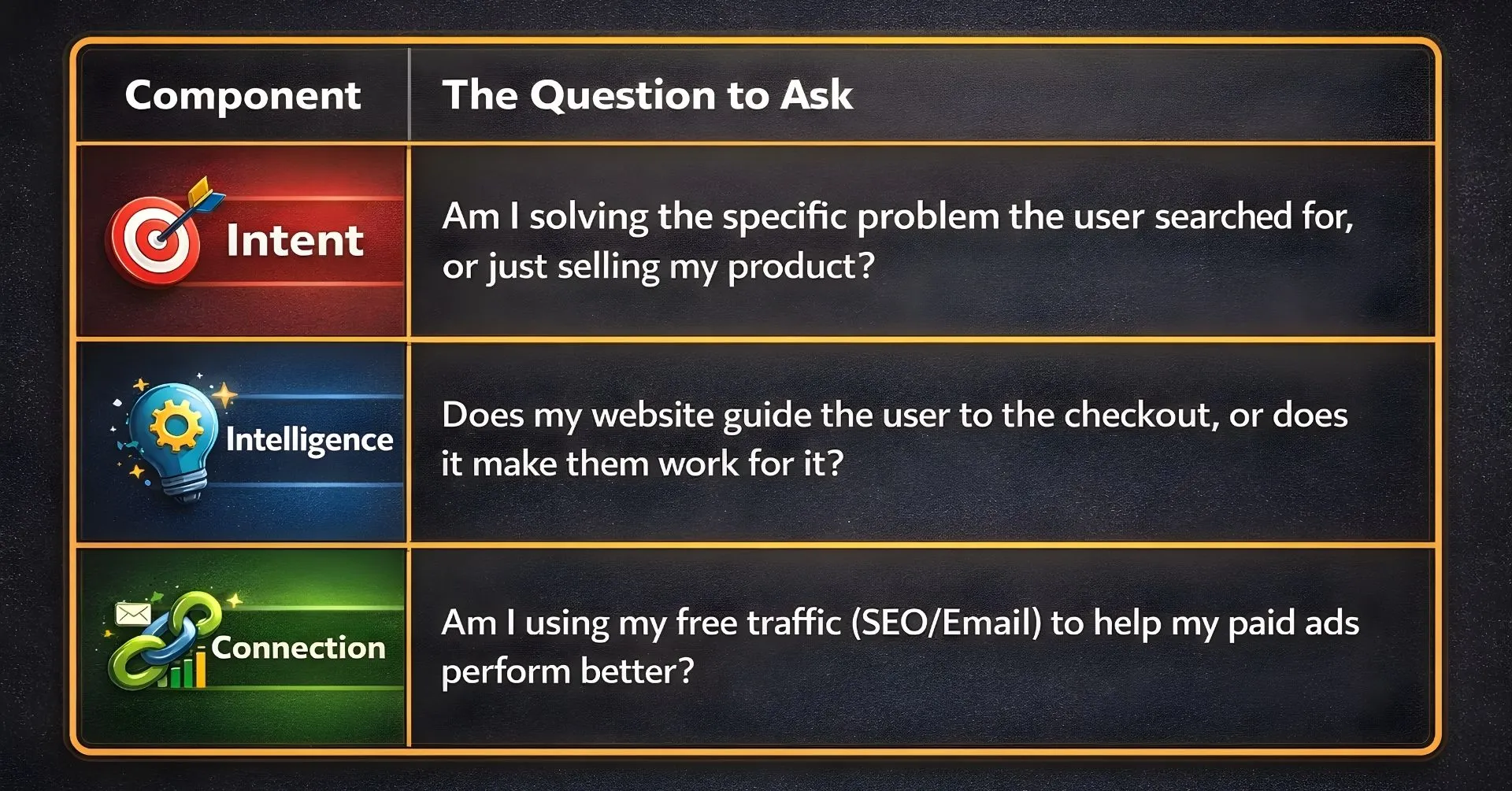
Pillar A: How well you understand "User Intent"
The Concept: In the past, we targeted keywords. If someone typed "running shoes," we showed them an ad for running shoes. Today, AI tries to figure out the why behind the search. Are they looking for "running shoes" because they want to run a marathon, or because they want to look cool at the mall?
The Human Explanation: Imagine you walk into a store and say, "I need a jacket."
- Old Way: The clerk throws a raincoat, a blazer, and a parka at you and hopes you catch one.
- New Way (AI Era): The clerk notices you are shivering and wearing a suit. They immediately hand you a warm, professional wool coat. That is understanding intent.
Real-World Example:
- The mistake: A furniture brand bids on "wooden table." They show the same ad to everyone. Their ROAS is low because half the people want a cheap $50 desk, and the other half want a $2,000 dining table.
- The System Fix: The brand uses AI tools to analyze data. They realize that users searching on Saturday mornings usually want high-end dining tables, while Tuesday night searchers want cheap office desks. They tailor the creative (images/video) to match that intent. Suddenly, clicks turn into buys.
Pillar B: How intelligently your website converts traffic
The Concept: You can pay for the best traffic in the world, but if your website is a "leaky bucket," your ROAS will reach zero. In the AI era, your website needs to actively help the user buy, not just sit there.
The Human Explanation: Think of your ad as an invitation to a party.
- The Ad: "Come to our amazing party! Free pizza!"
- The Website: The guest arrives, but the door is locked, the lights are off, and nobody knows where the pizza is.
- The guest leaves immediately. It doesn't matter how good the invitation (ad) was; the experience failed.
Real-World Example:
- The Mistake: A skincare brand drives traffic to a generic homepage. The user has to click four times to find the product they saw in the ad. They get frustrated and leave.
- The System Fix: The brand uses an "intelligent" landing page. When a user clicks an ad for "acne cream," the page dynamically changes to show testimonials about acne, ingredients that fight acne, and a big "Buy Now" button. Chatbots pop up asking, "Do you have dry or oily skin?" to guide them. The website does the selling, not just the ad.
Pillar C: How connected your organic and paid channels are
The Concept: Silos kill ROAS. If your SEO team (the people writing articles to rank on Google) doesn't talk to your Ads team (the people spending money), you are wasting budget. The new ROAS relies on these two feeding each other data.
The Human Explanation: Imagine a relay race.
- Old Way: The first runner (Organic Content) runs their lap, stops, puts the baton on the ground, and walks away. The second runner (Paid Ads) has to run back, pick it up, and start from a dead stop.
- New Way: The first runner passes the baton smoothly to the second runner at full speed.
Real-World Example:
- The Mistake: A company spends thousands on ads for a new keyword: "Best vegan protein." It’s expensive. Meanwhile, their blog already ranks #1 for that topic, but they aren't retargeting the people reading that blog.
- The System Fix: The brand notices that 5,000 people a month read their blog post "Top 10 Vegan Proteins." They stop spending money trying to find new customers. Instead, they spend a tiny budget showing ads only to the people who read that blog post. These people already trust the brand. The conversion rate skyrockets, and the ROAS triples.
3. The Shift: Ad Metric vs. System Metric
This is the most important takeaway.
Brands that treat ROAS as an Ad Metric:
- They obsess over the "Bid Cap" or changing the headline color.
- When sales drop, they blame the ad agency or the platform (Facebook/Google).
- Result: They struggle. They are fighting against the algorithm.
Brands that treat ROAS as a System Metric:
- They look at the whole pipe. If ROAS drops, they ask: "Is our checkout too slow? Is our product description confusing? Are we targeting the wrong intent?"
- They realize the ad is just the front door. The house is what matters.
- Result: They scale. The algorithm sees that people love their website, so it gives them cheaper traffic.
Summary Checklist
If you want to fix your ROAS, stop looking at the ads manager for a moment and check your system:
The D2C Market Problem Nobody Talks About
The D2C (Direct-to-Consumer) world is currently in a "silent crisis." If you run an online store or manage a brand, you likely feel it in your gut before you even see it in the spreadsheet.
The playbook that worked in 2018—buy cheap Facebook ads, drive traffic to a Shopify store, and watch sales roll in—is broken. Yet, many brands are still trying to run that same play, just with more money.
Here is a deep dive into the three hard realities of the current D2C market, why the standard reactions are failing, and what the actual solution looks like.
The Three Hard Realities
1. The "Expensive Noise" Problem (Ad costs up, Attention down)
The Reality: Digital advertising used to be like buying a billboard on a lonely highway; it was cheap, and everyone driving by had to look at it. Today, it’s like trying to whisper to someone in a crowded stadium during a touchdown.
- Ad Costs: Platforms like Meta and Google are mature. There is no "cheap" inventory left. You are bidding against massive global corporations.
- Attention Spans: Users are scrolling faster than ever. You don’t have 30 seconds to explain your product; you have 1.5 seconds to stop their thumb.
The Human Example: Imagine you are selling a premium coffee maker. Five years ago, you could run a 1-minute video explaining the brewing process. Today, a user on TikTok or Instagram Reels swipes away if the video doesn't entertain them instantly. You are paying more money for a smaller slice of their attention.
2. The "Window Shopper" Trap (Organic traffic without intent)
The Reality: Many brands celebrate high traffic numbers. "Look! 10,000 people visited our site this month!" But if those people came from a viral meme or a low-quality blog post, they aren't buyers—they are window shoppers.
The Human Example: Think of a physical store. If you hire a clown to perform outside, a huge crowd will gather (Traffic). They might even walk inside to get out of the rain. But are they there to buy your expensive luxury watches? No. They are just there. In D2C, this looks like "Vanity Metrics." High traffic looks good in a report, but if it doesn't convert, it just clogs up your customer support and skews your data.
3. The "Stalker" Effect (Retargeting is broken)
The Reality: Retargeting used to be magic. A user looked at a pair of shoes, and you showed them those shoes again on Facebook until they bought them. Now, due to privacy changes (like Apple's iOS updates) and ad fatigue, this is failing. Users are annoyed by repetitive ads, or they simply don't see them because ad-blockers and privacy settings hide them.
The Human Example: Imagine you went on a first date, and it was just "okay." Then, that person shows up at your office, your gym, and your grocery store, asking "Do you want to go out again?" It stops being persuasive and starts being creepy. Eventually, you just block them. That is what aggressive retargeting feels like to modern consumers.
The Three Hard Realities
1. The "Expensive Noise" Problem (Ad costs up, Attention down)
The Reality: Digital advertising used to be like buying a billboard on a lonely highway; it was cheap, and everyone driving by had to look at it. Today, it’s like trying to whisper to someone in a crowded stadium during a touchdown.
- Ad Costs: Platforms like Meta and Google are mature. There is no "cheap" inventory left. You are bidding against massive global corporations.
- Attention Spans: Users are scrolling faster than ever. You don’t have 30 seconds to explain your product; you have 1.5 seconds to stop their thumb.
The Human Example: Imagine you are selling a premium coffee maker. Five years ago, you could run a 1-minute video explaining the brewing process. Today, a user on TikTok or Instagram Reels swipes away if the video doesn't entertain them instantly. You are paying more money for a smaller slice of their attention.
2. The "Window Shopper" Trap (Organic traffic without intent)
The Reality: Many brands celebrate high traffic numbers. "Look! 10,000 people visited our site this month!" But if those people came from a viral meme or a low-quality blog post, they aren't buyers—they are window shoppers.
The Human Example: Think of a physical store. If you hire a clown to perform outside, a huge crowd will gather (Traffic). They might even walk inside to get out of the rain. But are they there to buy your expensive luxury watches? No. They are just there. In D2C, this looks like "Vanity Metrics." High traffic looks good in a report, but if it doesn't convert, it just clogs up your customer support and skews your data.
3. The "Stalker" Effect (Retargeting is broken)
The Reality: Retargeting used to be magic. A user looked at a pair of shoes, and you showed them those shoes again on Facebook until they bought them. Now, due to privacy changes (like Apple's iOS updates) and ad fatigue, this is failing. Users are annoyed by repetitive ads, or they simply don't see them because ad-blockers and privacy settings hide them.
The Human Example: Imagine you went on a first date, and it was just "okay." Then, that person shows up at your office, your gym, and your grocery store, asking "Do you want to go out again?" It stops being persuasive and starts being creepy. Eventually, you just block them. That is what aggressive retargeting feels like to modern consumers.
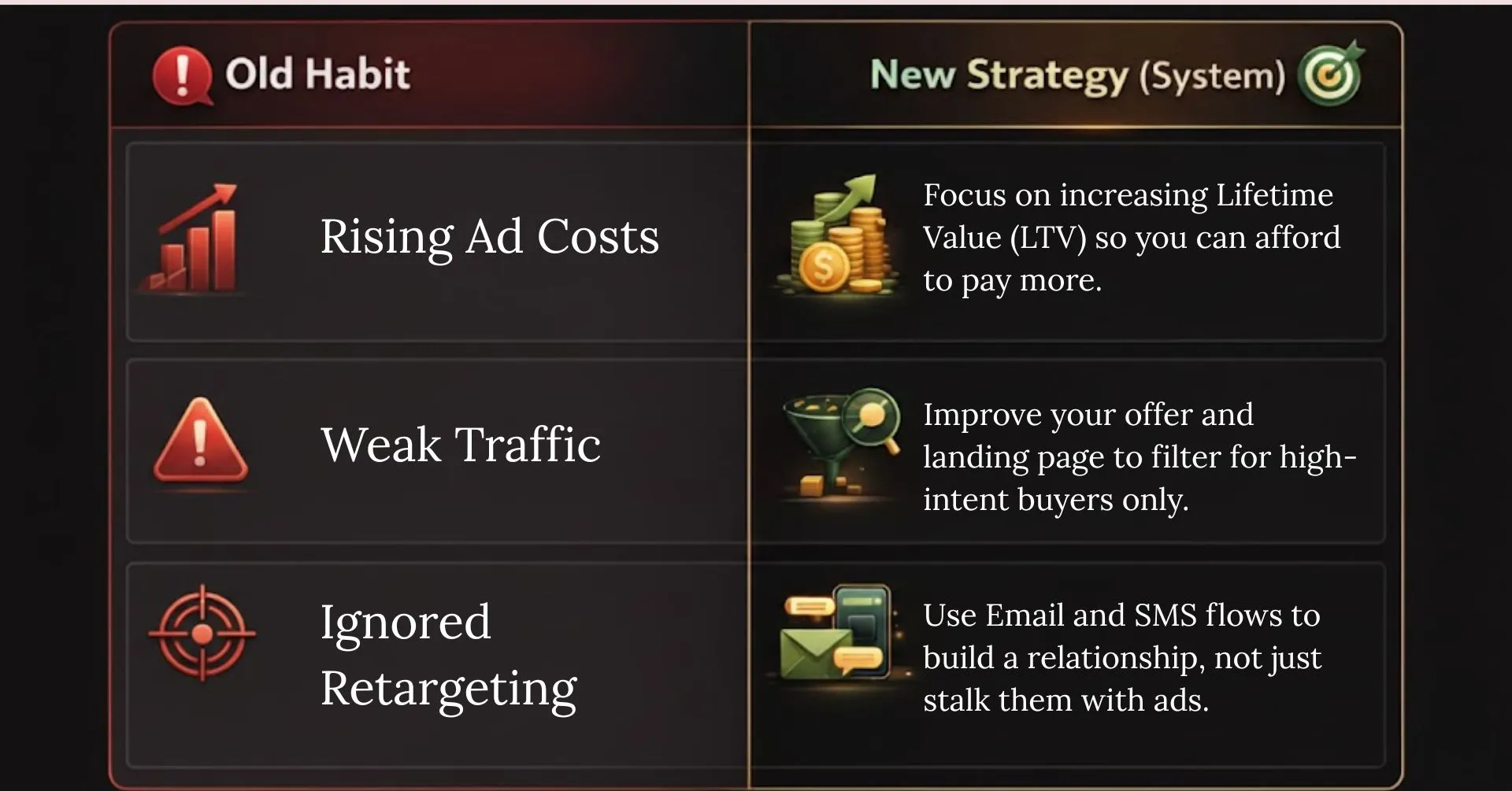
The Strategic Solution: The "Owned" Ecosystem
To survive this, you have to stop renting your audience and start owning it.
1. Shift from "Acquisition" to "Retention"
Stop obsessing over finding new customers and start obsessing over the ones you have.
- The Fix: If you sell skincare, don't just sell a bottle of lotion. Build a subscription model or a loyalty program that rewards them for coming back.
- Why it works: Selling to an existing customer is 5x–10x cheaper than finding a new one. This offsets the rising ad costs.
2. Build First-Party Data (The "Email/SMS" Goldmine)
You cannot rely on Facebook or Google to hold your customer data. You need their email and phone number.
- The Fix: Instead of asking for a sale immediately, ask for a connection. "Take our skin quiz to find your routine" (converts better than "Buy Now"). Once you have their email, you can market to them for free forever.
- Why it works: You bypass the expensive ad platforms entirely.
3. Brand Storytelling over "Hard Selling"
To beat the "Stalker Effect," your content needs to be valuable, not just salesy.
- The Fix: Instead of just showing the product, show the lifestyle. If you sell hiking boots, write guides on "The Best Trails in 2024."
- Why it works: People don't block helpful content. They welcome it. You become a trusted resource, not just a vending machine.
Summary for the D2C Founder
If you are stuck in the cycle of rising costs and lowering returns, take a step back.
Why Traditional Digital Marketing Is Failing D2C Brands
The digital marketing playbook that built the biggest D2C (Direct-to-Consumer) unicorns of the last decade is now the very thing killing new brands.
For a long time, marketing was a volume game. If you shouted loud enough and spent enough money, you won. Today, the game has changed from volume to precision. When you apply the old rules to the new game, you don't just lose—you go broke.
Here is a detailed breakdown of why the traditional approach is crumbling, written in plain English.
Part 1: The "Golden Era" (Why the Old Way Worked)
To understand the failure, we have to look at why it was so easy before. Imagine a time when digital real estate was virtually free.
1. Ads were cheap (The "Penny Stock" Phase)
- The Old Reality: You could put $1 into Facebook and get $5 back easily. The competition was low, so "renting" space on a user's newsfeed cost pennies.
- The Analogy: It was like buying beachfront property in the 1950s. You didn't need to be a genius investor; you just needed to be there early.
2. Audiences were broad (The "Shotgun" Approach)
- The Old Reality: You didn't need to know exactly who your customer was. You could target "Women in the US" and the algorithm would figure it out because it had unlimited access to user data.
- The Analogy: Fishing with a massive net. You caught a lot of junk, but you caught enough fish to make a huge profit.
3. Data was simple (The "Linear" Path)
- The Old Reality: A customer saw an ad, clicked it, and bought. Tracking this was a straight line.
- The Analogy: Walking down a hallway. Start at A, end at B. It was easy to see exactly which ad made the money.
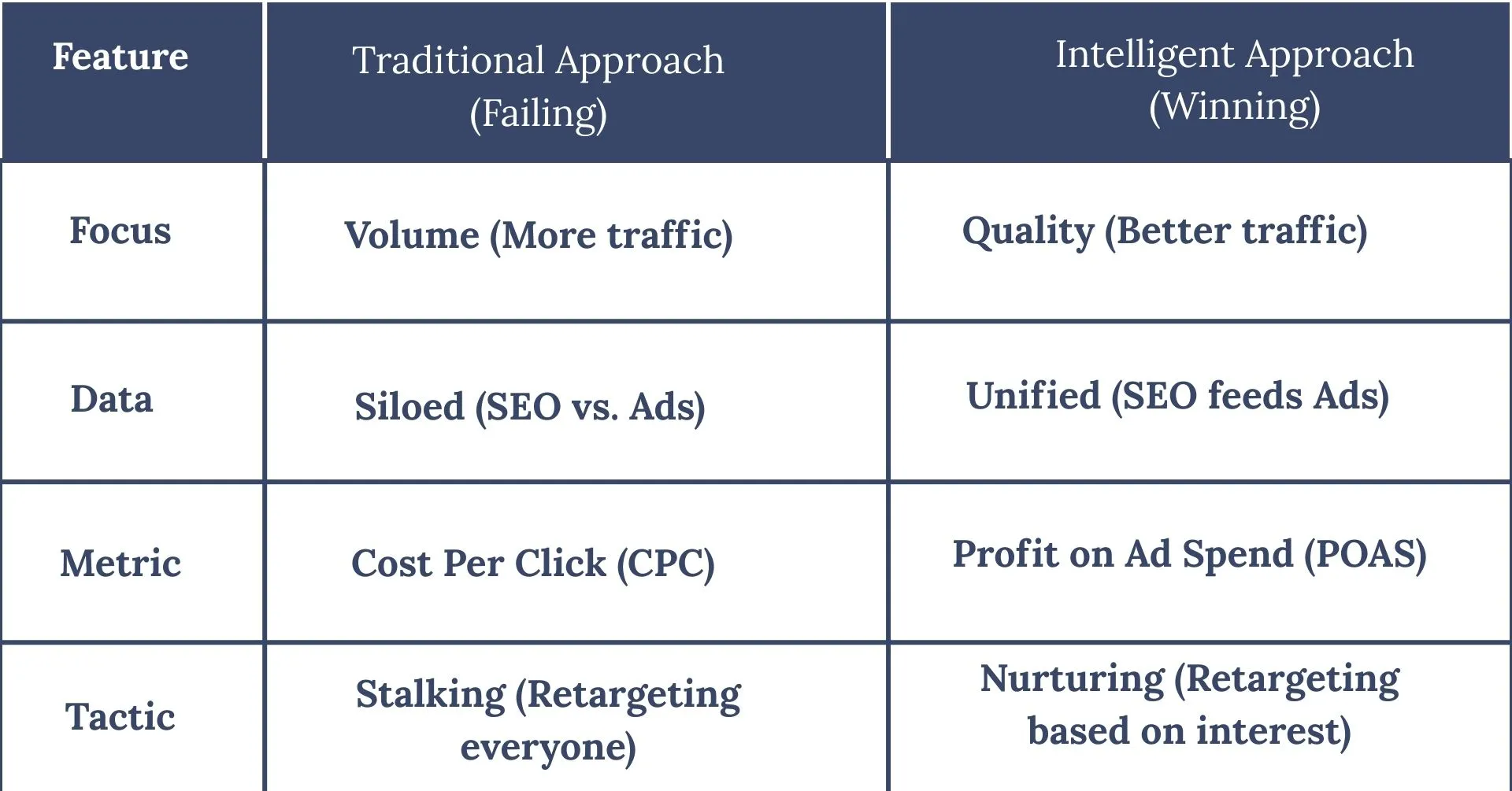
The Verdict: Marketing Without Intelligence is Just Noise
The difference between the old way and the new requirement is Intelligence.
-
- Traditional Marketing: Throws mud at the wall and hopes some sticks. It creates noise.
- Modern Intelligent Marketing: Looks at the wall, identifies the sticky spots, and aims only there. It creates profit.
How Adcliq360 Solves This with an AI-Centric Growth System
Pillar 1: AI-Optimized Organic Traffic (SEO + Website Intelligence)
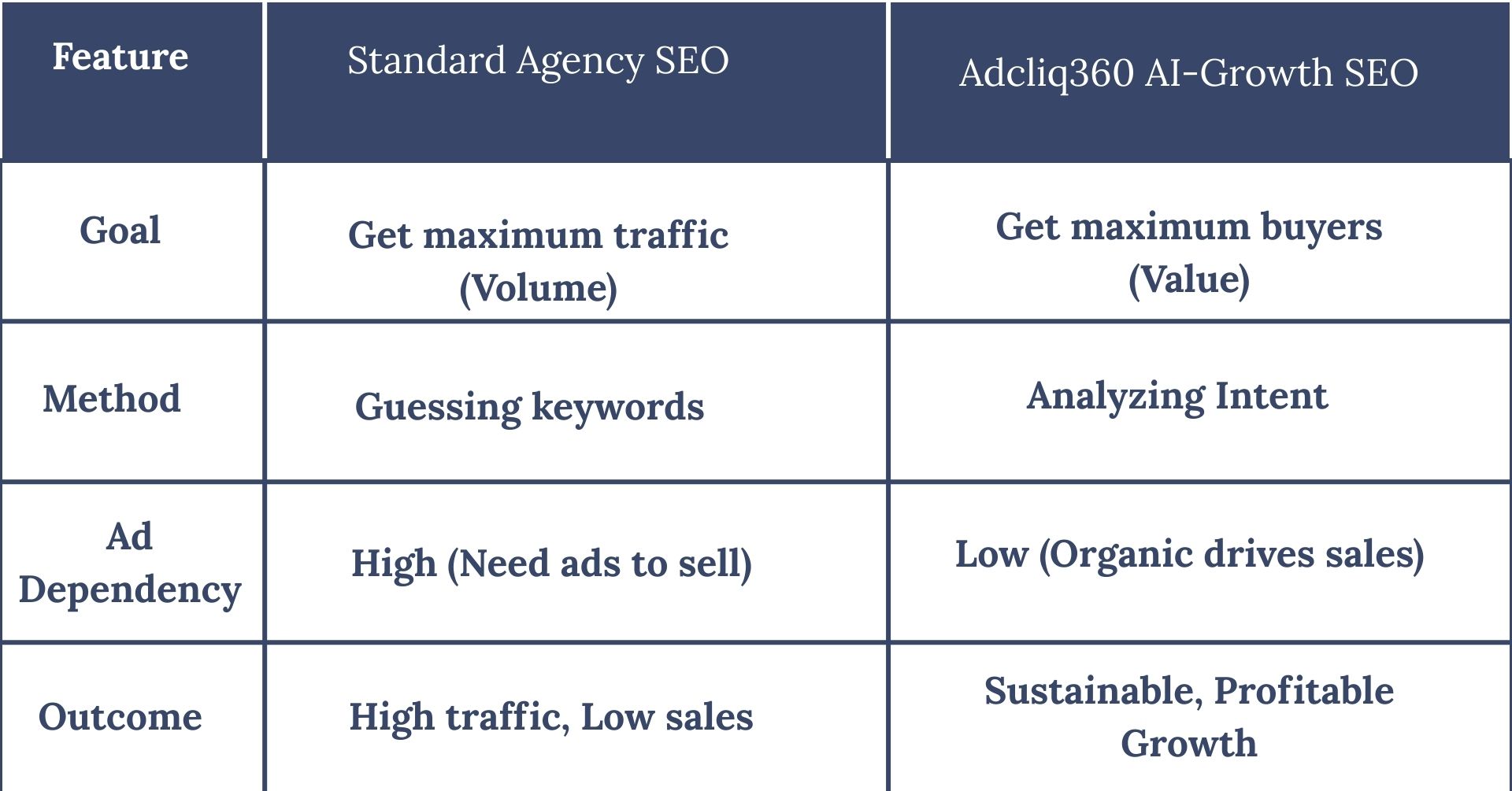
Most agencies treat SEO (Search Engine Optimization) like a game of Bingo. They stuff your website with keywords, write generic blog posts, and hope Google notices. It’s slow, and it often brings in traffic that never buys anything.
Adcliq360 does it differently. We don't just want more visitors; we want the right visitors. We use AI to reverse-engineer exactly what your customers are thinking before they even type a search.
Here is how our AI-Centric Growth System transforms your organic traffic:
1. We Use AI to Decode "Real Search Intent"
The Old Way: You target the keyword "Best Coffee." You get thousands of visitors, but nobody buys. Why? Because half of them are looking for a coffee shop nearby, and the other half are looking for recipes. You are ranking for the word, not the want.
The Adcliq360 Way: Our AI analyzes thousands of data points to understand the nuance behind the search. It tells us that a user searching for "low acid organic coffee beans fast shipping" is not browsing—they are desperate for a solution and ready to pay now.
- The Result: We focus your content on these specific, high-intent searches. We stop chasing "window shoppers" and start capturing "wallet-in-hand" buyers.
2. We Optimize Site Structure, Content, and UX
The Old Way: Your website is a static brochure. Every visitor sees the same headline, the same images, and the same layout. If they get confused, they leave. You have no idea why they left, only that they did.
The Adcliq360 Way: We treat your website as a living, breathing salesperson. We use AI tools to analyze User Experience (UX) in real-time.
- The "Heatmap" Intelligence: If our AI sees that 60% of users scroll past your "Buy Now" button because it's too low on the page, we know exactly what to fix.
- The Content Match: If a user lands on your site via a search for "Sensitive Skin Care," our system ensures the first thing they see isn't a generic "Welcome" banner, but a reassuring message about "Gentle formulas for sensitive skin."
- The Result: Friction is removed. The path from "Landing" to "Checkout" becomes smooth and obvious.
3. We Attract Users Who Are Already Closer to Buying
The Old Way: Traditional SEO focuses on "Top of Funnel" content—generic articles like "What is protein?" These users are months away from buying. You are educating them for free, and they will likely buy from a competitor later.
The Adcliq360 Way: We prioritize "Bottom of Funnel" traffic. We use AI to identify the specific questions users ask right before they purchase.
- The Shift: Instead of writing generic fluff, we create content that answers: "Is Brand X better than Brand Y?" or "Is this product safe for pregnancy?"
- The Result: You get fewer visitors than a viral news site, but your conversion rate skyrockets. You are catching the customer at the finish line, not the starting line.
Why This is a "System," Not Just a Tactic
When you get this pillar right, it changes the economics of your entire business.
Pillar 2: AI-Led Paid Media for Scalable Awareness
Most brands treat paid ads like a slot machine: they keep pulling the handle (spending money) hoping for a jackpot. Sometimes they win, sometimes they lose, but they never really know why.
Adcliq360 changes the game. We stop gambling and start calculating. We use AI to remove the emotion from decision-making, ensuring every dollar is working as hard as possible.
1. We Identify "High-Value Audience Signals"
The Old Way: You target broad groups like "Men aged 25-40 who like sports." This is wasteful. You are paying to show ads to thousands of people who might like sports but have zero interest in buying your sports gear right now.
The Adcliq360 Way: Our AI looks for invisible signals that a human media buyer would miss. It notices that your best customers aren't just "sports fans"—they are specifically people who visit fitness websites on Tuesday mornings and have purchased high-end sneakers in the last 30 days.
- The Human Explanation: Instead of handing out flyers to everyone in a stadium, we find the people standing in line at the concession stand with their wallets already out. We focus your budget only on them.
2. We Predict "Creative Fatigue" Before ROAS Drops
The Old Way: You run a great ad. It makes money for two weeks. Then, suddenly, performance crashes. You panic and scramble to make a new video, losing money every day while you figure it out.
The Adcliq360 Way: We use predictive AI to see the crash coming. Just like a weather forecast predicts rain, our system predicts when an audience is getting bored of an ad before they stop clicking.
- The Human Explanation: Think of your ad like a hit song on the radio. Eventually, people get sick of hearing it. Most brands wait until people are screaming "Turn it off!" to change the song. We swap the track while everyone is still tapping their feet, keeping the energy (and sales) high without a dip.
3. We Allocate Spend Dynamically Across Platforms
The Old Way: You set a fixed budget: "$1000 for Facebook, $1000 for Google." Even if Facebook is performing terribly that week, you keep spending that $1000 because that was "the plan."
The Adcliq360 Way: Our system acts like a smart day-trader. If Facebook becomes expensive on a Friday, but YouTube is offering cheap, high-quality traffic, the AI shifts the budget instantly.
- The Result: You are always buying the most under-priced attention in the market. You aren't loyal to a platform; you are loyal to profit.
Pillar 3: Intelligent Retargeting That Actually Converts
This is where most brands lose their reputation. Traditional retargeting is annoying—it follows you around the internet screaming "BUY THIS!" until you block it.
Adcliq360 does it differently. We turn retargeting from a "nagging" system into a "helper" system.
1. We Separate Users by Funnel Stage and Intent
The Old Way: Anyone who visits your site gets put in the same bucket. The person who accidentally clicked your link gets the same aggressive "Come Back!" ads as the person who spent 20 minutes reading your reviews.
The Adcliq360 Way: We categorize users based on behavior.
- The Window Shopper: Looked for 10 seconds. Strategy: Show them a brand video to build trust.
- The Researcher: Read your "About Us" and "Ingredients" page. Strategy: Show them testimonials and 5-star reviews to prove quality.
- The Cart Abandoner: Added to cart but left. Strategy: Show a limited-time discount or a "Low Stock" alert to trigger action.
2. We Personalize Messaging Instead of Repetition
The Old Way: Showing the exact same image of the exact same product 50 times. This causes "Banner Blindness"—the user's brain learns to literally not see your ad.
The Adcliq360 Way: If a user looked at "Red Shoes" but didn't buy, we don't just show them the Red Shoes again. Maybe we show them an ad about "How to Style Red Shoes" or "Why Our Soles Are the Most Comfortable."
- The Human Explanation: It’s the difference between a parrot repeating "Polly wants a cracker" and a conversation where a friend asks, "Hey, I saw you liked those shoes. Did you know they also come with waterproof lining?" One is annoying; the other is helpful.
3. We Control Frequency and Timing
The Old Way: Bombarding the user immediately. 10 ads in one day.
The Adcliq360 Way: We value the user's experience. Our AI monitors the "Frequency Cap." If a user hasn't clicked after seeing the ad 3 times, we back off. We might wait 48 hours before trying a different angle.
- The Result: We protect your brand image. You don't look desperate. When you do show up in their feed, they pay attention because you aren't spamming them.
The Final "System" Review
When you combine AI-Led Awareness with Intelligent Retargeting, the result is stability.
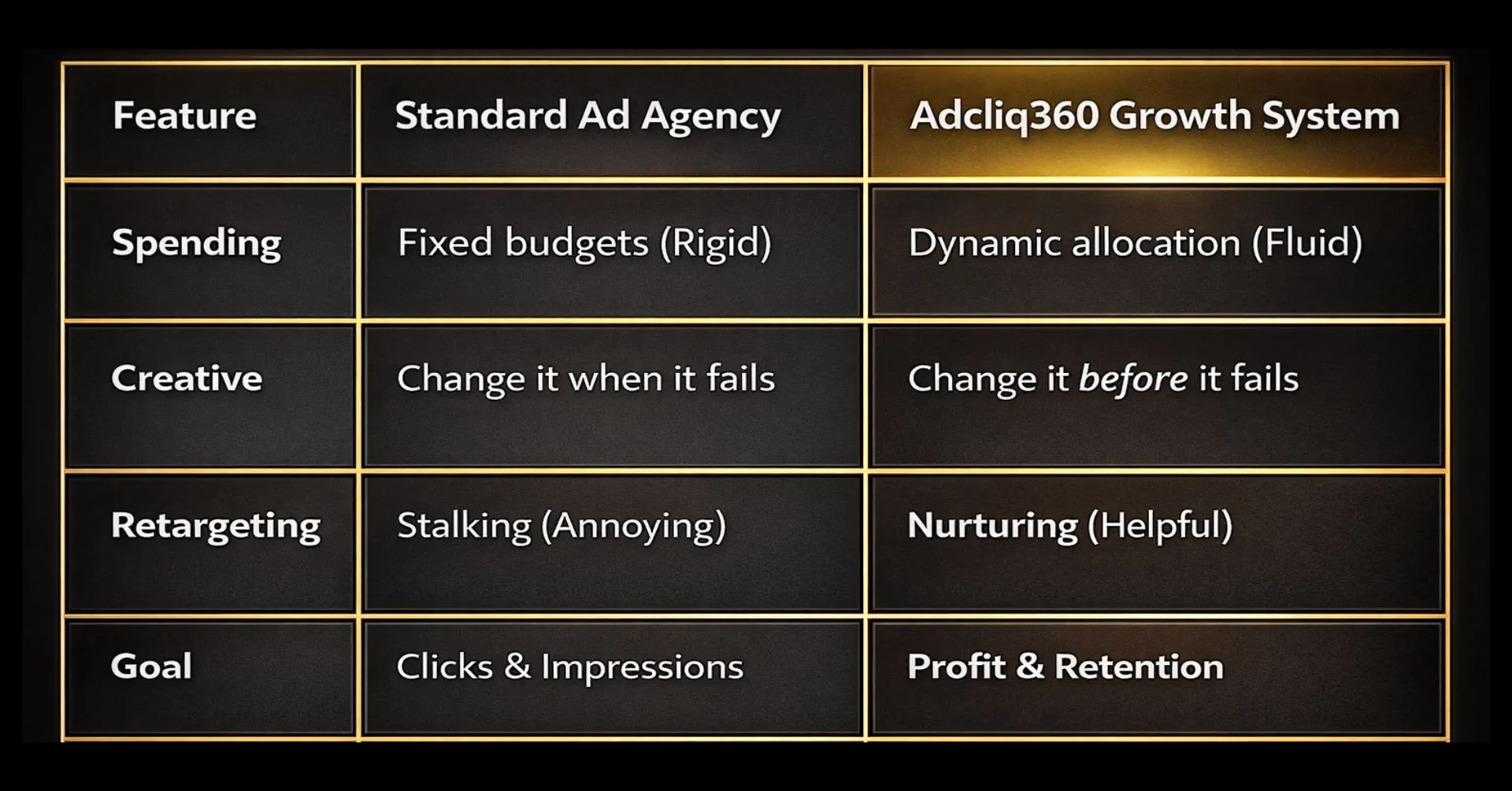
The Outcome: ROAS That Compounds, Not Spikes
In the world of online sales, there are two types of growth: the Sugar Rush and the Snowball.
Most agencies give you a "Sugar Rush." They slash prices, spam emails, or burn cash on ads to give you a massive spike in sales for one month. It feels great for a moment, but then the crash comes. The spike disappears, and you are back to square one, hungry for the next hit.
Adcliq360 builds a "Snowball." By connecting SEO, Ads, Website Experience, and Retargeting under one AI brain (guided by human experts), your results don't just go up and down—they stack on top of each other.
Here is what happens when you stop running campaigns and start building an engine:
1. CAC (Customer Acquisition Cost) Stabilizes
The Problem: If you only rely on paid ads, your CAC will always go up. Ad platforms raise their prices every year. If you paid $20 to get a customer in 2021, you might pay $40 today. This eats your profit margins alive.
The Adcliq360 Solution: We create a "Blended Ecosystem." Because we are building your Organic Traffic (which is free) alongside your Paid Traffic (which costs money), your average cost levels out.
- The Math: Even if Facebook ads get more expensive, your SEO is bringing in more free customers every month. The "free" customers balance out the "expensive" ones.
- The Human Analogy: It’s like investing. If you only keep cash (Paid Ads), inflation eats it. If you own real estate (Organic Content), your value goes up. We help you own the real estate so you aren't renting your growth forever.
2. Conversion Rates Improve
The Problem: Most brands try to fix low sales by pouring more traffic into the website. This is the "Leaky Bucket" syndrome. If your bucket has holes, pouring more water won't fill it; it just makes a mess.
The Adcliq360 Solution: Our system fixes the bucket. Because our AI understands intent and optimizes the User Experience (UX), the traffic we send actually buys.
- The Example: A traditional agency sends 1,000 people to your site, and 10 buy (1% conversion). Adcliq360 uses AI to fix your landing page and target better users. Now, we send the same 1,000 people, but 30 buy (3% conversion).
- The Result: You made 3x the money without spending a penny more on ads. That is the power of efficiency.
3. ROAS (Return on Ad Spend) Compounds Over Time
The Problem: A "Spike" is a one-time event. You run a Black Friday sale, ROAS hits 5.0, and the next day it drops back to 1.5. You are always starting over.
The Adcliq360 Solution: "Compounding" means your past success helps your future success.
- Data gets smarter: Every dollar we spend teaches the AI who your perfect customer is. Next month's targeting is automatically better than this month's.
- LTV increases: Because we use intelligent retargeting (not spam), customers come back for a second and third purchase.
- The Result: Your ROAS grows not because you got lucky, but because the system is getting smarter, your brand is getting stronger, and your customers are staying longer.
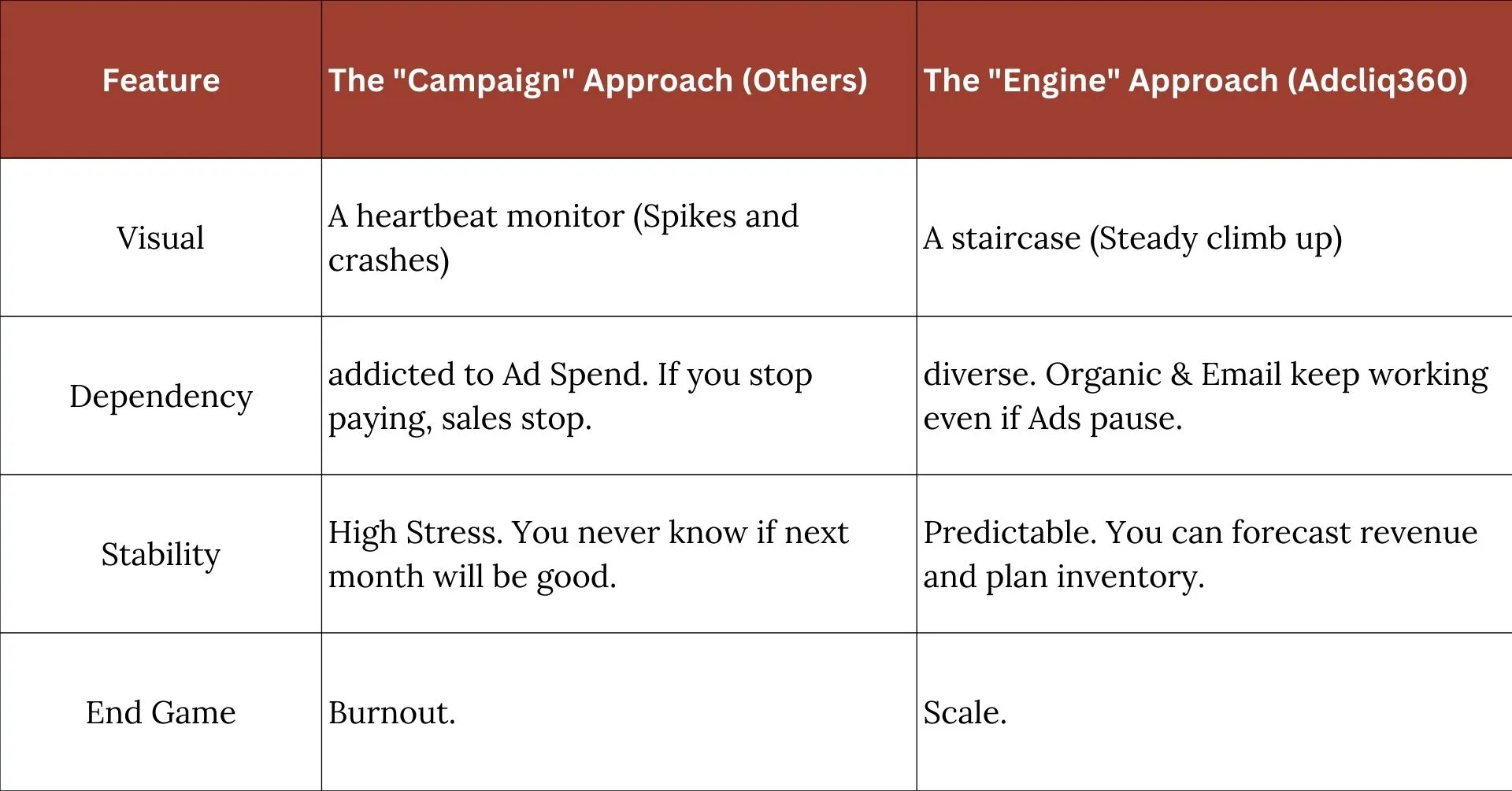
Disclaimer
"Adcliq360 doesn’t offer shortcuts — we build systems that last."
We aren't here to sell you a magic trick. Shortcuts in marketing usually lead to dead ends (like getting your ad account banned or ruining your brand reputation).
We are here to be the architects of your growth. We lay the bricks, pour the foundation, and install the wiring so that your brand can withstand market changes, price hikes, and new algorithms.
If you are a D2C brand ready to stop gambling and start scaling, you are ready for a system.
Frequently Asked Questions: The Evolution of D2C Marketing & AI
1. What is the difference between "Old ROAS" and "New ROAS" in 2026?
Historically, ROAS was a simple transaction: Revenue ÷ Ad Spend. In the AI era, New ROAS is a System Metric. It measures the efficiency of your entire digital ecosystem. Instead of just looking at ad bids, AI platforms now evaluate the "Total Experience," including user intent, website speed, and content relevance. If your system is flawed, your ads become more expensive, regardless of your budget.
2. Why are traditional D2C marketing strategies failing today?
Traditional strategies rely on "Volume over Precision," which leads to the "Expensive Noise" problem. With rising ad costs and shorter attention spans (roughly 1.5 seconds), the old playbook of buying cheap traffic and driving it to a generic store no longer works. Modern success requires an AI-Centric Growth System that prioritizes high-intent buyers over raw traffic numbers.
3. How does AI help in understanding "User Intent" for e-commerce?
AI goes beyond keywords to decode the "Why" behind a search. While traditional SEO targets broad terms like "coffee maker," AI analyzes behavioral data to distinguish between someone researching recipes and someone ready to purchase a premium espresso machine. By targeting the latter, brands can significantly increase their conversion rates and lower their acquisition costs.
4. What is a "Leaky Bucket" website in digital marketing?
A "Leaky Bucket" refers to a website that receives high traffic but fails to convert it into sales. This usually happens due to friction in the user journey—such as slow loading times, confusing navigation, or landing pages that don't match the ad's promise. AI tools help fix this by analyzing heatmaps and user behavior to create a frictionless path to checkout.
5. How does the "Stalker Effect" impact modern retargeting ads?
The "Stalker Effect" occurs when brands show the exact same ad to a user repeatedly across the internet, leading to ad fatigue and brand resentment. Modern Intelligent Retargeting avoids this by segmenting users based on their journey. Instead of repetitive "Buy Now" ads, it serves helpful content, such as product tutorials or social proof, to move the user closer to a purchase without being intrusive.
6. What is the "Owned Ecosystem" strategy for D2C brands?
The Owned Ecosystem strategy involves shifting focus from "renting" audiences on Facebook or Google to "owning" them through First-Party Data (Email and SMS lists). By building a direct line of communication with customers, brands can drive repeat sales for free, bypassing expensive ad auctions and stabilizing their profit margins.
7. How does AI-led Paid Media prevent "Creative Fatigue"?
AI-led systems use Predictive Analytics to monitor ad performance in real-time. Before your ROAS begins to drop, the AI identifies signals of "Creative Fatigue"—when an audience stops engaging with a specific visual or video. This allows brands to swap creative assets proactively, maintaining high performance without the typical "performance dip."
8. Why should SEO and Paid Ads be integrated into one system?
In the past, SEO and Paid Ads operated in silos. Today, an integrated system allows them to feed each other data. For example, if a blog post ranks #1 for a high-intent topic, you can run low-cost retargeting ads specifically for those readers. This "Blended Ecosystem" ensures your paid budget is spent on users who already trust your brand, leading to a much higher ROI.
9. What is the difference between "Sugar Rush" and "Snowball" growth?
- Sugar Rush Growth: Short-term spikes in sales driven by heavy discounts or aggressive ad spend that aren't sustainable.
- Snowball Growth: A compounding effect where AI optimizations, organic traffic growth, and customer retention build upon each other. Over time, your Customer Acquisition Cost (CAC) drops while your brand authority increases.
10. How does Adcliq360’s system differ from traditional ad agencies?
Most agencies focus on "Campaigns"—temporary efforts to boost numbers. Adcliq360 builds "Systems." By combining AI-led awareness, intent-based SEO, and intelligent retargeting, we create a self-optimizing engine. Our approach focuses on Long-term Stability and Compounding ROAS, ensuring your brand grows even when market conditions change.