
Published on August 08, 2024
Why Local SEO is Your Most Important Marketing Channel
You might be thinking, “What’s the big deal? I have a website, isn’t that enough?”

Consider these powerful statistics:
- 46% of all Google searches have local intent. This means that nearly half of the searches performed on the world’s largest search engine are from people looking for something in their immediate area. They aren’t just browsing; they are looking for a place to go or a service to use, right now.
- “Near me” searches have grown by over 400% year-over-year. This is not a slow trend; it’s a digital revolution. People are using phrases like “dentist near me,” “pizza shop near me,” or “mechanic near me” more than ever before. This is a clear signal of high-intent, ready-to-buy customers.
In essence, local search optimization is the art and science of ensuring your business shows up in these critical moments. It’s about being discovered by potential customers who are already in your neighborhood, ready to make a purchase. Ignoring this is like closing your shop’s doors to nearly half of all potential visitors.
1. The Core Foundation: Google Business Profile Optimization
Imagine a customer is in your city and searches for your service. The first thing they see is often the “local pack”—a small box at the top of the search results showing a map and a list of three businesses. Getting into that box is the ultimate goal of local SEO, and the single most important factor for this is your Google Business Profile (formerly Google My Business or GMB).
Your Google Business Profile (GBP) is your free digital storefront on Google. It’s how your business appears in Google Maps and local search results. Think of it as your virtual front door. A complete and optimized profile is the primary ranking factor for local search.
Here is your step-by-step guide to mastering it.
Step 1: Claim, Verify, and Complete Your Profile
This is non-negotiable. If you haven’t done it yet, stop everything and do it now.
- Claim Your Profile: Go to the Google Business Profile manager and search for your business. If it’s already listed, claim it. If not, create a new one.
- Verify Your Business: Google needs to confirm you are the rightful owner. The most common method is a postcard with a verification code sent to your physical address. Don’t skip this step. Businesses with a complete profile are 2x more likely to be considered reputable by consumers.
Once verified, fill out every single section of your profile. Every empty field is a missed opportunity. This includes:
- Business Name: Use your exact business name. Do not add extra keywords here, as Google considers this “keyword stuffing” and may penalize you.
- Address and Service Area: Be precise. If you are a service-area business (e.g., a plumber who visits customers), set your service area and hide your physical address.
- Business Hours: Keep these accurate and up-to-date, especially for holidays.
- Phone Number: Use a consistent number that matches your website and other listings.
- Website: Link to your official website.
Step 2: Master Your Category Selection
This is a powerful but often overlooked step.
- Choose a Primary Category: This is the most important choice you’ll make. Be specific, not broad. Instead of “Restaurant,” choose “Italian Restaurant.” Instead of “Doctor,” choose “Pediatrician.” This tells Google exactly what you do.
- Add Secondary Categories: You can add up to nine additional categories. This helps Google understand all the services you offer. For example, a “Pediatrician” might also add “Family Doctor” and “Vaccination Center.”
The right categories help you show up for relevant searches. A business with the wrong category will never rank well, no matter how good everything else is.
Step 3: The Power of NAP Consistency
NAP stands for Name, Address, and Phone Number. This might seem simple, but it is one of the most critical elements of local SEO.
Your NAP must be perfectly consistent across every single platform where your business is listed. This includes your website, your GBP, social media profiles (Facebook, Instagram), and online directories (Yelp, TripAdvisor, Yellow Pages).
Why is this so important? Search engines like Google crawl the web to verify information about your business. If they find conflicting information—for example, your address is “123 Main St.” on one site and “123 Main Street” on another, or your phone number has a different area code—it creates confusion. This lack of trust tells Google that your business might not be legitimate or reliable, which hurts your rankings.
Step 4: A Visual Content Strategy
Humans are visual creatures. When looking for a business, high-quality photos and videos can make a huge difference.
- Upload Regularly: Add new photos and videos of your business, your team, your products, and your customers (with their permission!). This signals to Google that your business is active and vibrant.
- Showcase Your Space: Upload photos of your exterior, interior, and key products. A potential customer looking for a cafe might want to see if the atmosphere is right for them. A customer looking for a lawyer might want to see a professional office.
- Geo-tag Your Images: If you’re tech-savvy, you can geo-tag your images with your business’s location. This adds another layer of verification and relevance.
Businesses with photos on their profiles get 42% more requests for driving directions and 35% more clicks to their websites than businesses without photos.
Step 5: Engage with Interactive Features
Your GBP is not just a static listing; it’s a dynamic engagement tool.
- Use Google Posts: Think of these as social media updates for your Google profile. You can post about special offers, new products, upcoming events, or blog posts. This keeps your profile fresh and gives potential customers a reason to click.
- Answer Questions in the Q&A Section: Anyone can ask a question on your profile. Take the time to answer these questions professionally and completely. This shows you are responsive and helpful.
- Enable Messaging: This feature allows customers to message you directly from your profile. It’s a fantastic way to handle simple inquiries and build a direct line of communication.
By actively managing your Google Business Profile and using these best practices, you are building the strongest possible foundation for all your other local SEO strategies. You are telling Google that your business is not only real and trustworthy but also active and customer-focused. This single step will have the most significant impact on your local search rankings.
Next, we’ll dive into the secret to getting found online: choosing the right words. We’ll explore how to conduct effective local keyword research and create a winning strategy that brings customers to your door.
2. The Search for Success: Local Keyword Research & Strategy
Imagine you have the most beautiful shop in the neighborhood, but no one knows what to search for to find you. That’s the challenge that local keyword research solves. It’s the process of identifying the exact words and phrases your potential customers use when they’re searching for businesses like yours.
Think of keywords as the digital signposts that guide people to your door. In the local world, they are a little different. Instead of just searching for “shoes,” a local customer is looking for “shoe store Mumbai” or “running shoes near me.”
This section will teach you how to think like your customer and find the keywords that will bring them to you.
Essential Keywords to Target for Local SEO
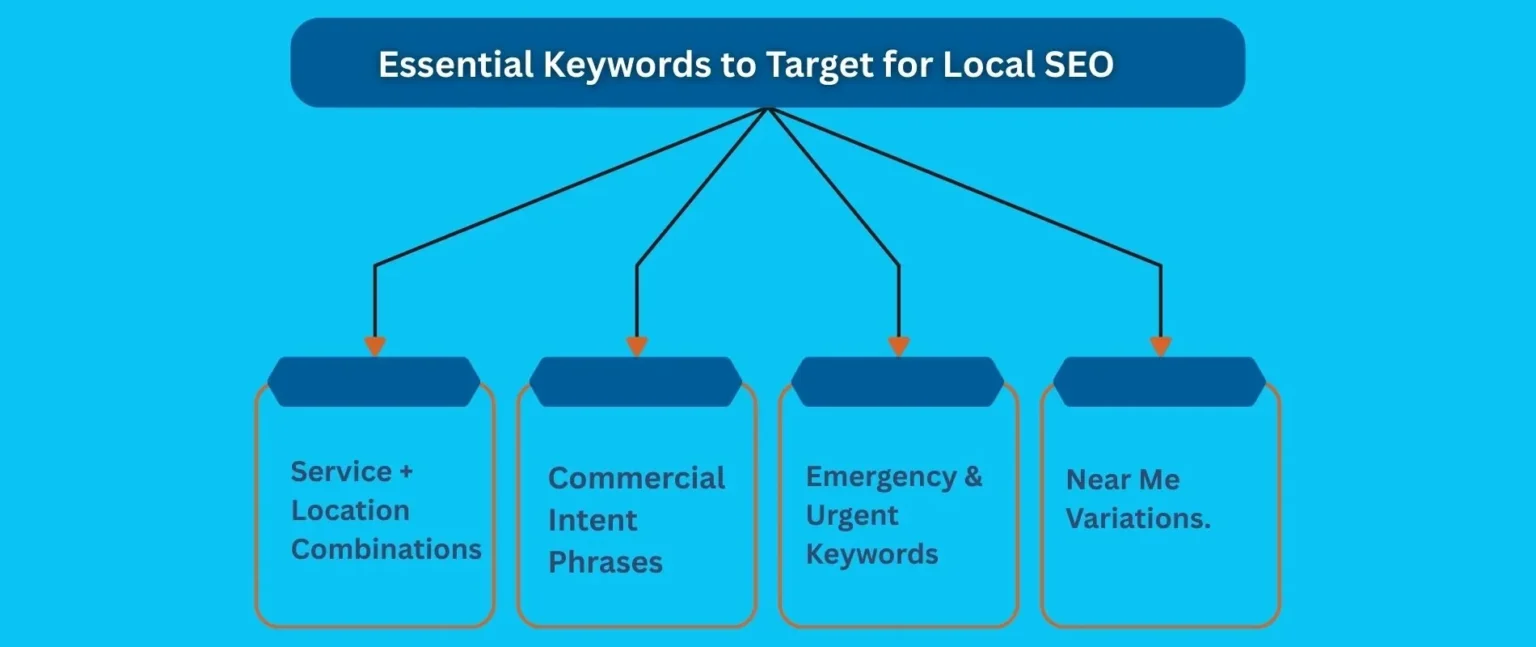
When it comes to local search optimization, not all keywords are created equal. Your strategy should focus on a mix of these high-intent phrases.
- Service + Location Combinations: This is the bread and butter of local search. These keywords are used by people who know what they want and where they are.
- Examples: “dentist in Chicago,” “best pizza in New Delhi,” “plumber in London.”
- “Near Me” Variations: As we saw in the introduction, this is the fastest-growing segment of local search. When a user searches for “coffee shop near me,” Google’s algorithm automatically uses their location to show them the closest and most relevant businesses.
- Examples: “dry cleaner near me,” “salon near me,” “Indian restaurant near my location.”
- Emergency & Urgent Keywords: These are used by people in a hurry and with a specific, time-sensitive need. Businesses that can capture this traffic often get an immediate sale.
- Examples: “24 hour plumber near me,” “emergency vet,” “car repair open now.”
- Commercial Intent Phrases: These are used by people who are ready to buy a specific product or service. They are often looking for where to purchase something locally.
- Examples: “where to buy organic vegetables in Bangalore,” “Honda parts shop in Pune,” “affordable tailor in Miami.”
- Voice Search Optimized Queries: With the rise of smart speakers and mobile assistants like Siri and Google Assistant, people are using natural, conversational language. Voice search queries are often longer and more question-based.
- Examples: “Hey Google, find a coffee shop near me that is open now,” “Siri, where is the nearest gas station?”
How to Find the Right Keywords (Tools & Techniques)
Finding these keywords isn’t about guessing; it’s about using the right tools and techniques. Here are some of the best ways to conduct your local keyword research.
Start with Google Autocomplete & “People Also Ask”
This is the simplest and most accessible method. Go to Google and start typing a service you offer, followed by your city or a nearby neighborhood. The suggestions that pop up in the dropdown are often high-volume keywords people are already searching for.
For example, if you are a baker in Chennai, type “baker Chennai.” You might see suggestions like:
- “bakeries in Chennai”
- “custom cakes Chennai”
- “home baker Chennai”
Scroll to the bottom of the search results page and look for the “Related Searches” section. This gives you more ideas for long-tail keywords. You can also look at the “People Also Ask” box, which reveals common questions your audience has. This is excellent for voice search local SEO optimization.
Use Google Keyword Planner
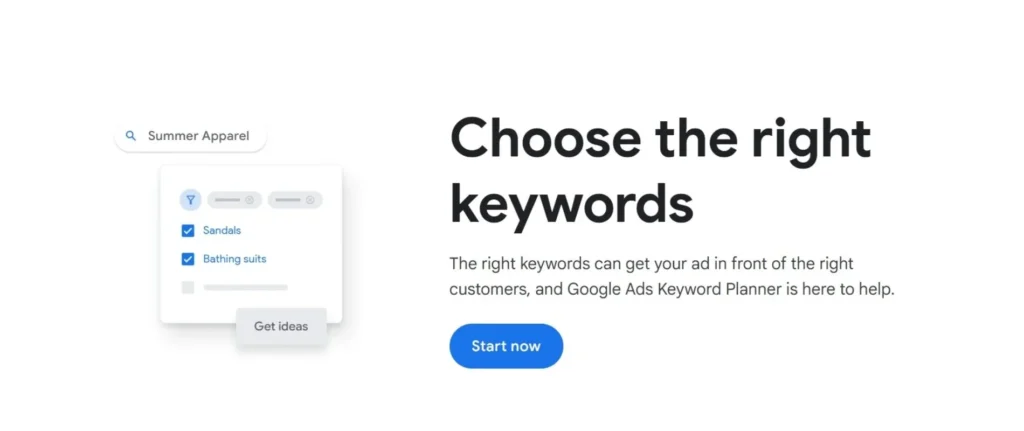
This is a free tool from Google that is part of Google Ads. While it’s designed for advertising, it’s incredibly useful for SEO. You can enter your keywords and get data on their average monthly search volume in your specific city, state, or country.
How to Use It:
- Enter a keyword like “dentist in Dallas.”
- Filter the results by your city (e.g., Dallas, Texas).
- The tool will show you the average number of searches per month and suggest related keywords. This helps you prioritize which keywords to target first.
Leverage Professional SEO Tools
If you want to get more serious about your keyword research, tools like Semrush, Ahrefs, and KWFinder are indispensable.
- Semrush: This tool is great for competitive analysis. You can enter your competitor’s website and see what keywords they are ranking for locally. This can give you a list of new keyword ideas you hadn’t considered.
- KWFinder: This tool is a favorite for finding long-tail keywords, which are less competitive and often have higher conversion rates. It’s a great way to find specific phrases that your customers are using. For example, instead of just “yoga classes in Mumbai,” you might find “Vinyasa yoga classes in Bandra.”
Create a Keyword Map
Once you have a list of keywords, you need a plan for where to use them. This is called a “keyword map.” It’s a simple chart that organizes your keywords by the page on your website you will use them on.
- Homepage: Target your primary, most competitive keywords (e.g., “dental clinic Atlanta”).
- Service Pages: Target specific service keywords (e.g., “cosmetic dentistry Atlanta,” “dental implants Atlanta”).
- Location Pages: If you serve multiple areas, create a unique page for each location and target keywords specific to that area (e.g., “dentist Sandy Springs GA”). This is a key strategy for neighborhood SEO strategies.
- Blog Posts: Target long-tail, informational, and “how-to” keywords (e.g., “what to do for a toothache before you see a dentist”).
By taking the time to research and organize your keywords, you are creating a smart, data-driven strategy. You’re not just hoping to be found; you are actively placing your business in front of the right people, at the right time. This strategic approach is what separates good local SEO from great local SEO.
Next, we’ll talk about how to use these keywords on your website itself to signal to Google that you are a highly relevant business for local searches. We’ll dive into the technical side of things, including on-page SEO elements and mobile optimization.
3. Optimizing Your Website: On-Page Local SEO Elements
Your Google Business Profile is the front gate, but your website is your home. To win the local search game, you need to make sure your website is perfectly organized and welcoming for both search engines and human visitors. On-page local SEO refers to everything you do on your own website to improve its local rankings.
Think of it as putting up clear signs and labels inside your store so customers can easily find what they’re looking for. By using the keywords you found in the last section, you’ll show Google that your site is a highly relevant resource for local searchers.
Technical Requirements: Making Your Website Shine
These are the foundational technical elements that every local business website needs to get right.
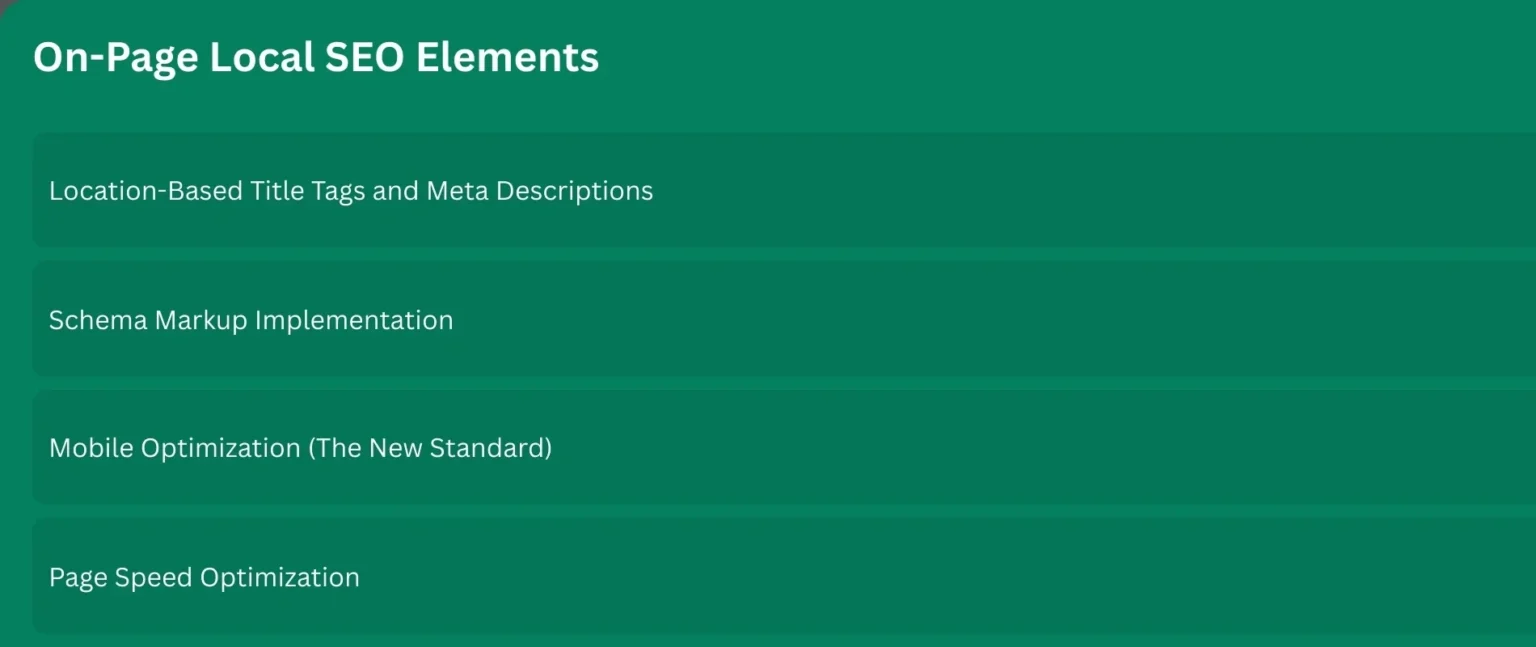
Location-Based Title Tags and Meta Descriptions
The title tag and meta description are the first things a user sees in the search results. They are your digital billboard.
- Title Tag: This is the clickable headline for your page. It should include your main keyword and your location.
- Example: [Service Name] in [City/Neighborhood] | [Your Business Name]
- Bad Example: Home Page or Best Plumber
- Good Example: Expert Plumber in New Delhi | Sharma Plumbing Services
- Meta Description: This is the short, descriptive text below the title. It should be a compelling summary of the page, including your keywords and a call to action. While it doesn’t directly affect rankings, it does influence whether a user clicks on your link, which is a major signal of relevance.
- Good Example: Need a reliable plumber in New Delhi? Sharma Plumbing Services offers 24/7 emergency service. Call us now for quick, professional help.
Schema Markup Implementation
Schema markup is a form of code that you add to your website to help search engines better understand your content. It’s like giving Google a detailed fact sheet about your business. For local SEO, this is incredibly powerful.
You’ll want to use LocalBusiness schema. This code explicitly tells Google your business name, address, phone number (NAP), business hours, reviews, and more. This makes it easier for Google to display your information accurately in search results, knowledge panels, and on maps.
- Why it Matters: It helps you stand out with “rich results”—extra information like star ratings, hours, or pricing that appears directly in the search results.
- How to Do It: While it may sound technical, there are tools and plugins (especially for platforms like WordPress) that can generate this code for you. You simply fill in your business details, and the tool creates the code you need to add to your website’s header or footer.
Mobile Optimization (The New Standard)
The majority of “near me” searches happen on mobile devices. A slow, difficult-to-use mobile site will frustrate users and make them click away, a phenomenon known as a high “bounce rate.” Google pays close attention to this.
- Responsive Design: Your website must be built with a responsive design, meaning it automatically adjusts its layout to fit any screen size, whether it’s a desktop, tablet, or smartphone.
- Touch-Friendly Navigation: Make sure buttons and links are large enough to be easily tapped with a thumb. Avoid tiny text and cramped menus.
Google now uses a “mobile-first index,” which means it primarily looks at the mobile version of your website to determine its ranking. If your mobile site is a mess, your local SEO will suffer.
Page Speed Optimization
Along with mobile-friendliness, a fast-loading website is essential. No one wants to wait for a page to load, especially a person on their phone who needs a service right now.
- Compress Images: Large image files are a common culprit for slow page speeds. Use tools to compress and optimize your images without losing quality.
- Optimize Code: Work with your web developer to “minify” your website’s CSS, JavaScript, and HTML files. This removes unnecessary characters and spaces, making the files smaller and faster to load.
- Use a Fast Web Host: The quality of your web hosting service directly impacts your site’s speed. Choose a reliable host that offers fast server response times.
Local Landing Pages for Multiple Service Areas
If your business serves more than one city or neighborhood, a single “contact us” page isn’t enough. You need to create dedicated local landing pages.
- How to Build Them:
- Create a unique page for each location you serve (e.g., yourwebsite.com/services/mumbai-plumbing and yourwebsite.com/services/pune-plumbing).
- Each page must contain unique, original content, not just copied and pasted text.
- On each page, include the local NAP, a map for that area, a list of services specific to that location, and testimonials from local customers. This proves to Google that you have a legitimate, relevant presence in that neighborhood.
By implementing these on-page local SEO elements, you are making your website a powerful tool for attracting local customers. You’re not just creating a digital brochure; you’re building a highly-optimized, location-specific resource that Google will love to show to your future customers.
Next, we’ll dive into the world of online reviews and how to manage them to boost your local rankings and build customer trust. We’ll show you why reviews are a critical part of the local SEO puzzle and give you a simple strategy for success.
4. The Power of Your Reputation: Review Management Strategy
In the world of local search optimization, your online reputation is everything. Today, a person is more likely to trust the opinion of a stranger in an online review than they are to trust a brand’s own advertising.

- 93% of consumers read online reviews before visiting a local business.
- Reviews are one of the most critical ranking factors for local search.
This means that a strong, positive review profile not only convinces customers to choose you but also tells Google that you are a legitimate, well-regarded, and trusted business. It’s a win-win for attracting both humans and search engine robots.
Why Reviews Are So Important to Google
Google’s job is to provide the best, most relevant results for every search. When someone searches for “best dentist near me,” Google uses reviews to help determine who is truly the “best.” Here’s what they look for:
- Quantity: Do you have enough reviews to be taken seriously? A business with 100 reviews is generally seen as more reliable than a business with only 5.
- Quality (Star Rating): What is your average star rating? A 4.5-star rating or higher is a strong signal of quality.
- Recency: Are your reviews fresh? A review from yesterday is more valuable than a review from five years ago. This shows your business is active and consistently satisfying customers.
- Keyword-Rich Content: Do the reviews mention your services, location, or products? When a customer writes, “The plumber in Pune from ABC Plumbing was amazing. He fixed my broken faucet quickly,” it reinforces your relevance for those keywords.
This combination of factors tells Google that you are a reputable and active business that deserves to rank highly.
Actionable Steps for Your Review Management Strategy
Getting reviews and managing them effectively is a process, not a one-time task. You need a system.
Step 1: Systematically Ask for Reviews
Most customers will not leave a review unless you ask them to. Don’t be shy! A simple, polite request can make a world of difference.
- Timing is Key: Ask for a review immediately after a successful service or a positive interaction. This is when the customer is happiest and most likely to leave a positive review.
- Make It Easy: The easier you make it, the more likely a customer is to follow through.
- Direct Link: Use the direct review link from your Google Business Profile. You can find this in your GBP dashboard. Share this link in a follow-up email or a text message.
- QR Codes: Print a QR code that links directly to your review page. You can place this on receipts, business cards, or signs at your front desk.
- Review Landing Page: Create a dedicated page on your website with clear links to your Google, Yelp, and other relevant review platforms.
- Never Offer Incentives: Google’s policy strictly forbids offering discounts, free items, or any other incentive in exchange for reviews. This is seen as “review gating” and can get your reviews removed or your profile penalized. Just ask for a genuine, honest review.
Step 2: Develop a Professional Response Strategy
Responding to reviews is as important as getting them. It shows both customers and Google that you are engaged and value feedback.
- Respond to All Reviews (Yes, All of Them!):
- Positive Reviews: Thank the customer by name. Personalize your response by mentioning something specific from their review. This shows you’re not using a canned response.
- Example: “Thank you so much, Priya! We’re so glad you enjoyed our coffee and pastries. We look forward to seeing you again soon!”
- Negative Reviews: This is your chance to shine. Responding professionally to a negative review can actually win over a new customer who is reading the exchange.
- 1. Respond Publicly and Take It Offline: Start with a public apology and a statement of your commitment to customer satisfaction. Then, offer to take the conversation offline to resolve the issue directly. Provide a phone number or email address.
- 2. Be Professional and Empathetic: Do not get defensive. Apologize for the customer’s experience, even if you don’t believe the facts are correct. Show that you understand their frustration.
- Example: “Hello, Raj. We are so sorry to hear that you had a negative experience. We pride ourselves on our service, and we missed the mark here. Please contact our manager, Anjali, at [Phone Number] so we can make this right for you.”
- Positive Reviews: Thank the customer by name. Personalize your response by mentioning something specific from their review. This shows you’re not using a canned response.
Step 3: Monitor Multiple Platforms
While Google is the most important, don’t forget about other review sites. Yelp, Facebook, TripAdvisor, and industry-specific directories are all places where your customers might leave reviews. Use tools or set up alerts to monitor these platforms so you can respond in a timely manner.
By proactively managing your reviews, you are not just cleaning up your reputation; you are building trust, boosting your local search rankings, and creating a powerful feedback loop that can help you improve your business.
Next, we’ll talk about the importance of citation building and NAP consistency to verify your business and boost its authority in the eyes of search engines. We’ll show you how to ensure your business information is flawless across the entire web.
5. Building Your Digital Footprint: Citation Building & NAP Consistency
We’ve talked about your Google Business Profile and your website, but what about the rest of the internet? For a search engine like Google to be truly confident that your business is legitimate and located where you say it is, it needs to see your information listed consistently across many different websites.
This is where citation building comes in. A citation is any online mention of your business’s Name, Address, and Phone number (NAP). It doesn’t have to be a link to your website; a simple mention is enough to act as a “vote of confidence” for your business.
Think of it this way: if a person asks ten of your friends where you live, and all ten friends give the exact same address, that person will be very confident in your location. If five friends give one address, and five give another, they will be confused and lose trust. The same logic applies to search engines.
Core Concepts of Citation Building
1. Citations Verify Business Existence
Every time a credible website lists your business information, it signals to Google that you are a real, legitimate company. The more mentions Google finds, the more trustworthy and prominent your business appears. Citations help search engines confirm your business’s details, which is a key factor in how they rank you.
2. Consistency is Crucial
This is the most important rule of all. Your NAP must be perfectly consistent across every single listing. Any small discrepancy can hurt your local SEO.
- “Street” vs. “St.”
- “Road” vs. “Rd.”
- “Suite 200” vs. “Ste. 200”
- Phone number with hyphens (123-456-7890) vs. no hyphens (1234567890)
While these may seem like minor details, they can confuse search engines. Your best practice is to choose one format and stick to it everywhere. Use your Google Business Profile as your master reference and make sure every other listing matches it exactly.
3. Quality Over Quantity
It’s better to have a few high-quality citations than hundreds of low-quality or spammy ones. Focus on the most important directories and platforms first.
- The Core Citations:
- Google Business Profile: This is your number one priority.
- Major Data Aggregators: These are services that collect and distribute business data to hundreds of other sites. In the U.S., these include Factual, Infogroup, and others.
- Major Directories: Yelp, Apple Maps, Bing Places, and Facebook are essential for every business.
- Industry-Specific Directories: These are often more valuable than general directories. For a law firm, a directory like Avvo is more powerful than a generic listing. For a restaurant, TripAdvisor and Zomato are crucial.
- Geographically-Specific Directories: Look for local business associations, your city’s Chamber of Commerce, or local news websites that have business directories.
How to Build Citations and Fix Inconsistencies
Step 1: Conduct a Citation Audit
Before you start building new citations, you need to find and fix any incorrect ones that already exist. This is the single most effective step you can take.
- Manual Search: Search for your business name and variations of your NAP in Google. Use a spreadsheet to keep track of every listing you find.
- Use an Audit Tool: Tools like Moz Local or BrightLocal can automatically scan hundreds of directories for you and highlight any inconsistencies.
Step 2: Fix Found Inconsistencies
Once you have your list, start correcting any inaccurate information.
- Contact the Directory: The best way to correct a listing is to claim it and edit the information yourself. If you can’t, contact the website’s support team and ask them to update your details.
- Delete Duplicate Listings: Sometimes, a business can have multiple listings on the same directory, which creates confusion. If you find duplicates, get them removed.
Step 3: Build New Citations
After your foundation is clean, you can start building new, high-quality citations.
- Manual Submission: Go to the most important directories one by one and manually create or claim your listing. This gives you the most control.
- Use a Service: Many companies offer services to build and manage your citations for you. This can be a good option if you have a lot of listings to manage and don’t have the time to do it yourself.
By maintaining a clean and consistent NAP across the web, you’re not only helping search engines trust you but also ensuring that your customers always have the right information to find and contact you. This foundational work pays off with higher rankings and a stronger digital presence.
Next, we will explore local link building. We’ll show you how to earn links from other local businesses and organizations, which is one of the most powerful signals of authority in local SEO.
6. Building Authority in Your Community: Local Link Building Strategies
In the world of SEO, a link from another website to yours is like a vote of confidence. When a high-quality, reputable website links to you, it tells Google, “This business is a trusted authority in its field.” For local SEO, this concept is even more powerful. A link from a local newspaper, a community organization, or a neighboring business sends a strong signal of local relevance and authority.
Think of it as word-of-mouth marketing for search engines. It’s not just about getting any links; it’s about earning links from websites that are directly relevant to your community and your industry.
Why Local Links Matter for Rankings
Google’s algorithm considers links a primary ranking factor. For local search, links from local sources are especially valuable because they reinforce your connection to a specific geographical area. They tell Google that you are a well-regarded member of the community.
A link from a local business blog, a community non-profit’s website, or a local news outlet is worth more for your local SEO than a link from a random, unrelated national website.
Effective Local Link Building Tactics
Here are some of the best ways to earn high-quality links from local sources.
1. Community Partnerships and Event Sponsorship
This is one of the most natural and effective ways to build local links.
- Sponsor a Local Event: Sponsor a youth sports team, a local festival, or a community charity event. In exchange for your sponsorship, they will almost always include your business logo and a link on their website’s “Sponsors” page.
- Donate to a Local Non-Profit: Many charitable organizations list their donors on their website.
- Partner with a School: Offer to give a presentation, sponsor a school event, or provide materials. This can lead to a link from the school’s website, which is often a very authoritative source.
These activities not only earn you valuable links but also build goodwill in your community and get your business in front of local people.
2. Local Business Collaborations for Cross-Promotion
Look for other non-competing businesses in your area that share your target audience. You can create mutually beneficial partnerships.
- Joint Promotion: If you own a bridal shop, you could partner with a local wedding photographer or a catering company. You could write a guest blog post for their website, and they could do the same for yours.
- Co-Host an Event: Work with a neighboring cafe to host a joint event. Both businesses can promote the event on their websites, creating a link exchange.
This kind of collaboration is a powerful way to tap into each other’s audience and earn high-quality links at the same time.
3. Create Locally-Focused Content
Content is a powerful tool for earning links. Create blog posts, guides, or resources that are uniquely valuable to your local community.
- “Best of” Guides: Write an article like “The Best Coffee Shops in [Your City]” or “Top 5 Hiking Trails Near [Your Location].” If your content is well-researched and useful, other local bloggers and websites might link to it as a resource.
- Local Data and Research: Conduct a local survey or study related to your industry. For example, a real estate agent could publish a report on local housing market trends. This kind of unique data is highly linkable.
- Highlighting Other Local Businesses: Write a blog post or create a video series that features other great businesses in your area. This is a great way to build relationships and encourage others to link to you.
4. Local News Coverage
Getting your business mentioned in local news outlets is an excellent way to earn high-authority links.
- Issue a Press Release: Have something newsworthy to announce? Did you launch a new product, hire a key employee, or win an award? Write a press release and send it to local newspapers, magazines, and online news sites.
- Become a Source for Journalists: Position yourself as a local expert in your field. If a journalist is writing a story about your industry, offer to provide a quote or an interview. This can often result in a link back to your website.
5. Participate in Community Forums and Local Directories
- Community Forums: Actively participate in online forums or social media groups for your city. Answer questions related to your expertise, and if appropriate, link to a relevant resource on your website.
- Local Directories: While we discussed this in the last section for citations, many of these directories also provide a valuable link back to your website.
By engaging in these activities, you are not just building links; you are building your reputation and cementing your business as a trusted, valuable member of your community. This is a key part of any comprehensive local SEO strategy 2025 and beyond.
Next, we’ll look at the exciting future of local SEO. We’ll explore emerging trends like voice search and AI integration and give you a glimpse into what you need to prepare for to stay ahead of the curve.
7. The Future Is Now: Emerging Trends for 2025
The world of search is constantly changing. What worked a few years ago might not be enough today. To stay ahead of your competition, you need to understand the new technologies and trends shaping the future of local search optimization. For 2025, two major forces are at play: Voice Search and Artificial Intelligence (AI).
Trend 1: Voice Search Optimization
The way people search is becoming more conversational. Instead of typing short, choppy phrases, they are speaking full sentences into their phones, smart speakers (like Google Assistant and Alexa), and smartwatches. A staggering 76% of people use voice search weekly for local searches. This shift changes the keywords you should target and the way you structure your content.
- Target Conversational, Long-Tail Keywords: Instead of optimizing for “pizza Chicago,” you need to think about phrases like, “Hey Google, where can I find the best pizza shop near me that’s open late?” or “Siri, what’s a good place for a family dinner in downtown Chicago?”
- Create Question-and-Answer Content: Voice search queries are often in the form of a question. Create blog posts or a detailed FAQ section on your website that directly answers these questions. For example, a dentist’s website could have a page titled, “What to do if you have a toothache?”
- Optimize for Featured Snippets: Voice assistants often read a concise, direct answer to a question from a website that has earned a “featured snippet” (also known as “Position Zero”) on Google. To get there, your content needs to be well-structured, easy to read, and provide a clear, one-to-two-sentence answer to a question right at the top of the page.
Trend 2: AI Integration in Search Results
In 2025, AI is not just a trend; it’s a fundamental part of how Google delivers search results. AI models like Google’s Gemini are now providing direct answers and summaries, often called “AI Overviews,” right at the top of the search results page. This means users get their answer without ever clicking on a website.
- Focus on ‘Machine Legibility’: AI doesn’t see your website the way a person does. It needs to read and understand your information perfectly. This makes things like LocalBusiness schema markup and consistent NAP data more important than ever. You are no longer just persuading people; you are persuading a machine to recognize you as a relevant, trustworthy entity.
- User-Generated Content and Reviews: AI places a heavy emphasis on trustworthiness and authenticity. It looks at reviews and online chatter to form its summaries. This means your review management strategy, as we discussed earlier, is now a crucial part of getting featured in AI Overviews. AI interprets a business with a lot of consistent, positive reviews as highly credible.
- Diversify Your Presence: AI pulls information from a wide range of sources, not just websites. This means your business needs to be active on platforms like Instagram, Facebook, and even local forums. Think of it as creating a “distributed, platform-ready content” strategy. The more places the AI finds consistent, high-quality information about your business, the more likely it is to feature you.
Trend 3: Hyper-Local Content
While we’ve talked about location-based keywords, the future is about getting even more specific. As search becomes more personalized and AI understands context better, businesses need to create content that speaks to the nuances of their specific neighborhood or community.
- Create Guides to Your Neighborhood: A local bakery could write a blog post about “The Best Walking Tour of [Your Neighborhood]” and mention other local businesses.
- Highlight Local Events: A cafe could post on their Google Business Profile about a local festival happening on their street, demonstrating their involvement in the community.
These trends show a clear shift. Success in local SEO in 2025 is not just about keywords and links; it’s about building a holistic, trustworthy, and active digital presence that search engines can easily understand and recommend to users.
Conclusion: Your Local SEO Checklist for 2025
Congratulations! You’ve now completed your journey through the world of local SEO best practices. You have the knowledge to not only compete but to win. Remember that local SEO is an ongoing process, not a one-time task. Consistency and attention to detail are your most powerful tools.
To help you get started, here is a simple local SEO checklist for small business success.
- Google Business Profile: Claim and verify your profile. Fill out every section completely and accurately.
- NAP Consistency: Audit your business information across all online platforms and fix any inconsistencies.
- Local Keyword Strategy: Research the keywords your local customers are using and create a plan for where to use them.
- Website Optimization: Ensure your website is mobile-friendly, loads quickly, and uses location-based title tags and schema markup.
- Review Management: Create a system for requesting and responding to reviews professionally on all platforms.
- Local Citations: Build your presence on key directories and industry-specific websites.
- Local Link Building: Actively seek partnerships and collaborations to earn links from other local businesses and organizations.
- Future-Proofing: Start creating content that is optimized for voice search and is highly readable for AI.
By following this guide and making these steps a part of your marketing routine, you will ensure that your business is not just another pin on a map, but a thriving, well-known part of your local community, both in the physical world and online.