
Published on November 18, 2025
Ever feel like you’re pouring money into ads but not sure what you’re getting back? That’s where Cost Per Lead (CPL) steps in. It’s a simple yet powerful metric that tells you exactly how much you’re paying to get someone interested in your business.
Whether you run a salon, fitness center, ecommerce store, or real estate firm, knowing your CPL can help you spend smarter and get better results. At Adcliq360, we believe every business—big or small—deserves full clarity when it comes to lead generation.
In this guide, we’ll walk you through everything you need to know about CPL: what it means, how to calculate it, how to improve it, and why it’s key to growing your business.
What is Cost Per Lead (CPL)?
Cost Per Lead (CPL) is a marketing metric that tells you how much you spend to acquire one lead—someone who shows interest by filling out a form, signing up, or requesting a quote. It helps measure how effective your ads are at generating potential customers. The formula is: Total Ad Spend ÷ Number of Leads.
Example: If you spend ₹5,000 on ads and get 100 leads, your CPL is ₹50. A lower CPL means you’re getting leads more cost-effectively, which is great for your return on investment (ROI).
Why Should Every Business Track CPL?
CPL isn’t just a number on a report. It’s a reflection of how well your marketing is working.
When you track CPL, you can:
Know exactly where your money is going
Compare platforms (Google, Facebook, YouTube, etc.)
Spot what’s working—and what needs fixing
Maximize returns on your marketing budget
Bottom line: if you’re spending money to get leads, you should know how much each one costs. Otherwise, it’s like driving with your eyes closed.
Examples of Cost Per Lead (CPL) in Different Industries
eCommerce Industry
An online fashion store runs Google Ads to promote its new summer collection. The total ad spend is ₹15,000 and they receive 500 email sign-ups for exclusive offers.
CPL = ₹15,000 ÷ 500 = ₹30 per lead
In eCommerce, a low CPL helps businesses build a larger customer base for retargeting and future sales.
Real Estate Industry
A real estate company launches a Facebook Ads campaign to generate interest in a new housing project. They spend ₹25,000 and receive 100 inquiries via the contact form.
CPL = ₹25,000 ÷ 100 = ₹250 per lead
In real estate, even a high CPL is acceptable due to the high value of each potential property sale.
Education Sector
An edtech platform promotes its online UPSC course using Instagram Ads. The ad budget is ₹5,000 and they get 200 leads through sign-up forms.
CPL = ₹5,000 ÷ 200 = ₹25 per lead
In the education industry, CPL helps measure how effectively ads are bringing in students for courses, webinars, or demo classes.
Healthcare Industry
A private dental clinic runs a Google Ad campaign offering free dental check-ups. The clinic spends ₹8,000 and gets 160 appointment bookings.
CPL = ₹8,000 ÷ 160 = ₹50 per lead
In healthcare marketing, CPL is useful to track how efficiently new patients are being acquired through paid advertising.
B2B Services
A software company runs LinkedIn Ads targeting business decision-makers for a demo of its SaaS tool. The company invests ₹50,000 and gets 200 high-quality leads.
CPL = ₹50,000 ÷ 200 = ₹250 per lead
In B2B marketing, Cost Per Lead is a key metric as it reflects the effectiveness of lead generation efforts for high-value clients.
How to Calculate CPL (With Real Example)
Here’s the easy formula: CPL = Total Ad Spend / Total Number of Leads
Example from Adcliq360: We ran a campaign for a dental clinic:
Ad Spend: ₹10,000
Leads Generated: 120
CPL = ₹10,000 / 120 = ₹83
That means each lead cost them ₹83. They converted 30% of those leads into paying customers—which made the investment totally worth it.
Average CPL by Industry (So You Know Where You Stand)
CPL can vary widely based on your industry, your audience, and the platform you’re using.
Here are a few ballpark figures:
Healthcare: ₹50 – ₹150
Real Estate: ₹150 – ₹400
E-commerce: ₹30 – ₹90
Education: ₹80 – ₹200
Fitness & Wellness: ₹70 – ₹200
Don’t stress if your CPL is outside these ranges. What really matters is whether your leads are turning into customers.
What Affects Your CPL? (And How to Improve It)
Audience Targeting: Showing ads to the wrong people? You’re just burning cash. Narrow your audience to match your ideal customer.
Ad Creatives: Dull ads don’t get clicks. Eye-catching visuals and sharp copy make a huge difference.
Landing Page Design: If people click your ad but bounce off the page, your CPL will skyrocket. Keep it clean, clear, and fast.
Platform Choice: Google might bring higher-intent leads, but Facebook might get you volume. Choose based on your goals.
Timing: Run ads when your audience is active. Late-night ads might get clicks, but not serious leads.
Your Offer: A free consultation or discount can pull in more quality leads.
Competition: In high-demand industries, you may need to outbid others—raising your CPL.
CPL vs CPA vs CPC — What’s the Difference?
| Metric | What It Means | Tells You |
| CPL | Cost Per Lead | How much to get an interested user |
| CPA | Cost Per Acquisition | How much to get a paying customer |
| CPC | Cost Per Click | How much per ad click |
Simple Example: Let’s say:
CPL = ₹50 (getting a lead)
CPA = ₹500 (getting a customer)
CPC = ₹10 (getting a click)
Each metric helps you understand a different step of the buyer journey.
6 Ways to Reduce Your CPL (Without Losing Lead Quality)
In the world of performance marketing, getting leads is just half the job — getting them at the right cost is what makes or breaks your ROI. Many businesses struggle with high Cost Per Lead (CPL) because they either chase quantity over quality or try to save money in the wrong places.
The good news? You can lower your CPL without sacrificing lead quality — and in some cases, even improve it. At AdCliq360, we’ve helped businesses across industries—from real estate to education—optimize their CPL with these six proven methods.
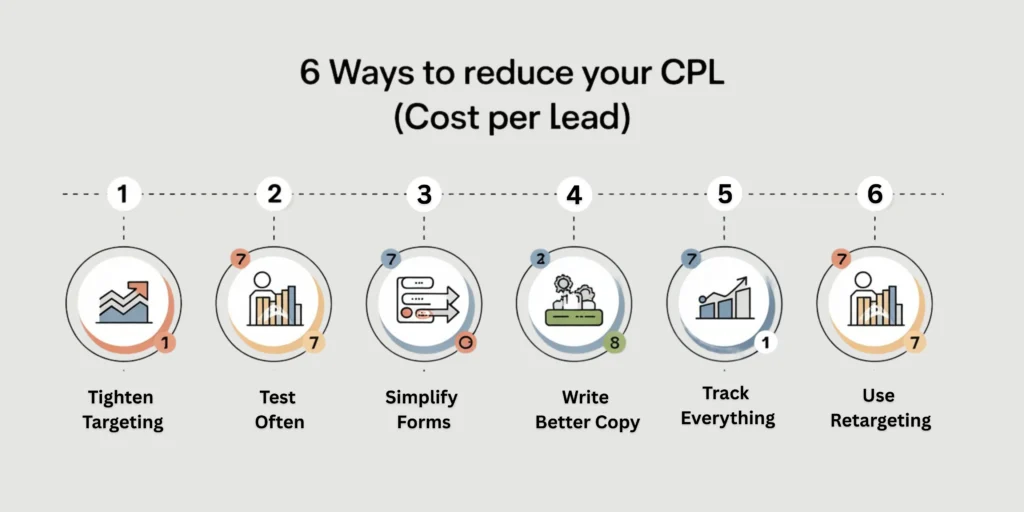
Want more leads without spending more? Here’s what we recommend at Adcliq360:
1. Refine Your Audience Targeting
One of the biggest reasons CPL goes up is poor targeting. If your ads are showing to people who aren’t even in your ideal customer group, you’re wasting money.
Take an example: An edtech brand promoting NEET prep courses was showing ads to working professionals aged 30+. No surprise—CPL was through the roof. Once we narrowed the audience to students aged 16–21, CPL dropped by 37%.
Smart targeting tips:
Use detailed interests and behavior filters
Create custom & lookalike audiences based on existing leads
Use geo-targeting to focus only on high-conversion locations
The more focused your audience, the better your lead quality—and the lower your CPL.
2. Optimize Your Ad Creatives and Copy
No matter how perfect your targeting is, if your ad creatives don’t click (pun intended), people won’t engage. And that leads to high CPL.
We once worked with a fitness brand that used generic product images. The ads were ignored. After switching to real client transformations with emotional messaging, their CPL dropped by 42% in under a month.
Here’s what works:
Use high-quality, mobile-first visuals
Highlight benefits, not just features
Make your CTA bold and action-driven (“Get Your Free Plan” > “Know More”)
Test video formats—they often outperform static images
High-performing creatives lead to higher CTR, better conversion, and lower cost per lead.
3. Improve Your Landing Page Experience
Your landing page is the deal-breaker. If people click your ad but don’t convert, it doesn’t matter how cheap the clicks were — your CPL will spike.
What makes a landing page convert?
Loads in under 3 seconds
Clear headline and value proposition
Short, distraction-free lead form
Trust signals like testimonials, certifications, and privacy info
One of our clients—a dental clinic—saw their CPL drop from ₹120 to ₹50 after switching from a cluttered homepage to a focused landing page with one CTA and strong social proof.
4. Test Everything with A/B Testing
Marketing without testing is like shooting in the dark.
A/B testing lets you experiment with variations and double down on what works. From headlines and CTAs to colors and ad placements, even small changes can make a big difference.
For example:
Test two versions of the same ad with different copy
Try short vs. long landing pages
Compare video ads to carousel posts
Make it a routine—test something every week. More data = smarter decisions = lower CPL.
5. Simplify Your Lead Forms
Long, complicated forms are conversion killers. If you ask for too much upfront, users will bounce.
Instead:
Stick to essential fields (Name, Email, Phone)
Use smart autofill and mobile-friendly input fields
Avoid CAPTCHA unless absolutely necessary
We ran a campaign for a webinar where shortening the form from 6 fields to 3 increased conversion rate by 2x — and CPL dropped from ₹80 to ₹38.
Simple forms don’t mean unqualified leads — they mean less resistance at the first step.
6. Use Retargeting to Convert Warm Traffic
Most people won’t convert the first time they see your ad—and that’s okay.
Retargeting helps bring those warm users back at a lower cost. In fact, CPLs in retargeting campaigns are almost always lower than in cold campaigns.
Retargeting ideas:
- Facebook/Instagram dynamic retargeting
- Google Display ads for non-converting visitors
- WhatsApp or email reminders for users who didn’t complete the form
One of our real estate clients dropped their CPL from ₹300 to ₹180 using just a basic retargeting strategy—with no extra ad spend.
Best Platforms for CPL Campaigns (And What Works Where)
Google Search Ads: Great for people actively searching. Higher intent, but usually higher CPL.
Meta (Facebook/Instagram): Fantastic for lead volume at lower costs. Needs strong visuals and clear CTAs.
LinkedIn: Pricier, but excellent for B2B leads.
YouTube/OTT: Great for storytelling and branding. Pair it with a solid lead magnet.
Email Marketing: If you already have a list, this is your lowest CPL channel.
Pick platforms based on your goals—not trends.
How Adcliq360 Helps You Get Better Leads for Less
We don’t just run ads. We run campaigns that work.
Here’s how we help reduce CPL and boost quality:
Build custom landing pages that convert
Write conversion-driven ad copy
Run deep analytics on user behavior
Optimize campaigns daily
Plug into your CRM for real-time lead flow
Example: One of our fitness clients cut their CPL by 42% in 4 weeks. More leads, better results, same budget.
Final Thoughts: Why Cost Per Lead (CPL) is the Backbone of Smart Performance Marketing
In today’s competitive digital world, blindly spending on ads is not a strategy—it’s a mistake. Tracking your Cost Per Lead (CPL) gives you the clarity, control, and confidence to run campaigns that actually deliver results. Whether you’re a startup or a growing business, CPL helps you understand the true value of your ad spend and ensures that every rupee is working toward quality lead generation.
From Google Ads to Facebook, and from real estate to eCommerce, CPL is the one metric that ties your entire performance marketing strategy together. When you monitor and optimize CPL, you’re not just reducing costs—you’re improving ROI, increasing conversions, and scaling with intention.
At Adcliq360, we treat CPL as more than just a number. We treat it as a growth engine. Our team doesn’t just focus on traffic—we focus on high-converting leads that move the needle for your business. Through custom landing pages, precise targeting, advanced analytics, and daily campaign optimization, we help brands reduce CPL and maximize lead quality without increasing budgets.
If you’re ready to stop guessing and start growing, it’s time to measure what matters.
Let Adcliq360 audit your current campaigns and show you how to lower your CPL while boosting performance—because better leads mean better business.